Engineered High-Rise Pallet Racking Systems
Explore specialized industrial pallet racking configurations designed for maximum structural stability, space utilization, and automated throughput.
Whitepaper: Engineering Principles of High-Rise Pallet Racking
Understanding structural mechanics, column profile geometry, and load-deflection limitations in high-bay logistics facilities.
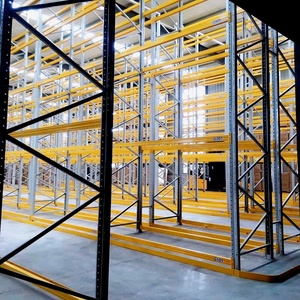
Modern logistics real estate economics demand extreme vertical volumetric efficiency. As land acquisition costs rise globally, warehouse operators are transitioning from traditional 6-to-8-meter storage heights to advanced high-rise pallet racking installations ranging from 12 to over 40 meters in height. Sourcing high-rise racking systems, however, requires rigorous engineering oversight. Unlike standard low-bay shelving, high-rise racking operates under complex dynamic stress vectors, structural buckling risks, and tight deflection tolerances mandated by automated handling equipment such as VNA (Very Narrow Aisle) turret trucks and ASRS (Automated Storage and Retrieval System) stacker cranes.
Leading global pallet racking manufacturers build structural resilience through advanced cold-rolled steel profiling. Steel grades such as Q355B and Q235B high-tensile structural coil undergo multi-stage precision roll-forming to create multi-flanged upright columns. The inclusion of continuous stiffening ribs along upright profile faces significantly increases the radius of gyration, enhancing axial compressive strength while minimizing structural weight. Furthermore, beam-to-column connection geometry is critical; teardrop and diamond-lock connector hooks engineered with self-locking safety pins prevent accidental beam dislodgement under high-velocity forklift operations.
Structural Profile Optimization
Multi-fold upright profiles engineered with high-strength structural steel maximize section modulus, resisting torsional rotation and second-order P-Delta buckling effects under extreme vertical payload capacities.
Beam Deflection Deflection Limits
Compliant with FEM 10.2.02 and EN 15512 international standards, horizontal beam profiles are designed to limit maximum deflection under full load to strictly less than L/200 (Span / 200), preserving clearance for automated shuttles.
Seismic Isolation Integration
Custom baseplate layouts, heavy-duty floor anchor bolts, and specialized horizontal/vertical bracing trusses dissipate kinetic energy during seismic acceleration events, keeping tall storage structures intact.
Strategic Procurement & Future Technological Trends
Analysis of emerging warehouse automation, rack-clad building integration, and ESG-compliant coating standards.
The global industrial storage manufacturing landscape is undergoing a shift driven by supply chain digitisation and labor shortages. B2B procurement directors and warehouse operations leaders must account for key macro trends when selecting a supplier or factory partner for high-rise racking infrastructure:
1. Convergence of Automated Radio Shuttles & 4-Way Intelligent Runners
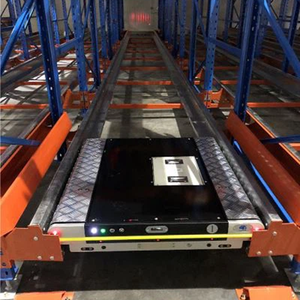
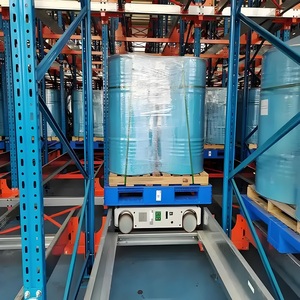
Traditional high-density storage like Drive-In racking is rapidly being superseded by semi-automated and fully automated radio shuttle systems. Modern 4-Way pallet runners navigate multi-level racking grids autonomously, communicating via 5G or industrial Wi-Fi networks. Sourcing high-rise racking for shuttle integration demands dimensional manufacturing tolerances within ±1.0 mm to prevent track jams and sensor errors.
2. Rise of Rack-Supported Building Structures (Rack-Clad Warehouses)
In high-bay rack-clad building construction, the racking steel frame itself forms the structural load-bearing infrastructure supporting wall cladding, roof trusses, and insulation panels. This eliminates the need for separate structural steel building columns, maximizing internal volume and reducing capital construction timelines by up to 25%.
3. Advanced Coating & Environmental Sustainability Standards
Procurement teams are prioritizing ESG compliance. Factories are migrating toward lead-free epoxy-polyester electrostatic powder coating systems with high salt-spray resistance (500+ hours). For cold-chain logistics and humid coastal zones, hot-dip galvanizing (HDG) compliant with ISO 1461 is becoming standard for lifetime corrosion resistance.
Engineering Comparison Matrix for Industrial Racking
Objective metrics to evaluate storage density, selectivity, automated equipment compatibility, and structural application suitability.
| Racking Architecture | Volumetric Efficiency | Pallet Selectivity | Stock Handling Flow | Max Height Range | Automated Equipment Fit |
|---|---|---|---|---|---|
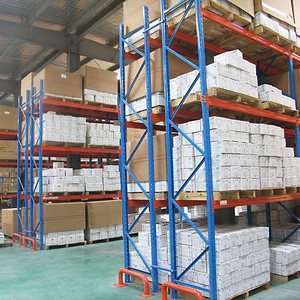
| Selective Pallet Racking | Standard (40-50%) | 100% Direct Access | FIFO / LIFO | Up to 12 Meters | Standard Reach Truck / Counterbalance |
| Very Narrow Aisle (VNA) | High (70-80%) | 100% Direct Access | FIFO / LIFO | Up to 18 Meters | VNA Turret Truck / Wire-Guided System |
| Radio Shuttle System | Ultra-High (85-90%) | Filtered by Lane | FIFO or LIFO | Up to 25 Meters | Intelligent 2-Way / 4-Way Radio Shuttle |
| ASRS Rack-Clad Systems | Maximum (90-95%) | 100% Computer Controlled | Fully Automated FIFO | Up to 45 Meters | Automated Stacker Crane & Conveyors |
| Drive-In Racking | High (65-75%) | Low (Per Lane) | Strict LIFO | Up to 10 Meters | Counterbalance Forklift inside Lanes |
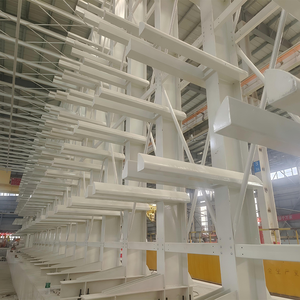
| Cantilever Racking | Custom for Long Goods | 100% Open Access | Any Flow | Up to 12 Meters | Side Loader / Forklift |
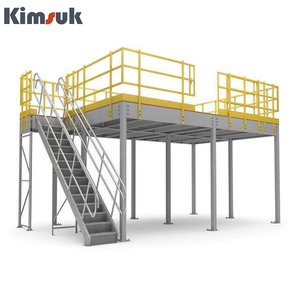
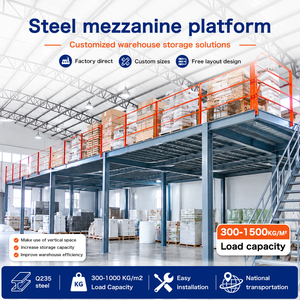
| Mezzanine Platform Rack | Doubles/Triples Floor Space | 100% Manual/Cart Access | Flexible | Multi-Tier (2-4 Levels) | Goods Lift / Vertical Conveyors |
Enterprise Manufacturing & Factory Technical Capabilities
Inside the production standards, quality inspection protocols, and global delivery frameworks of top-tier racking factories.
A reliable high-rise pallet racking factory must demonstrate end-to-end engineering authority, from raw steel coil quality verification to final export container packaging. Premium manufacturers located in industrial steel manufacturing hubs, such as Shandong Province, China, leverage vertically integrated automated machinery to maintain continuous structural quality across large-scale orders.
In-House Automated Cold Rolling
Equipped with modern multi-pass continuous cold roll-forming production lines, upright columns are formed with minimal thermal stress, preserving steel tensile strength and tight dimensional tolerances across every profile length.
Robotic Welding & Structural Integrity
Beam connectors and structural baseplates are joined using automated robotic GMAW/MIG welding cells. Continuous seam welds undergo periodic ultrasonic and magnetic particle non-destructive testing (NDT) to prevent weld fatigue failure under dynamic loading.
Full Component Traceability
Every manufacturing heat number, steel chemistry analysis report, and powder coat thickness log is tracked. Certified factories maintain rigorous ISO 9001 quality management systems and CE conformity compliance certificates.
Export-Grade Bundle Protection
Structural upright frames and beam bundles are strapped with heavy-duty steel bands, edge-protected with corner guards, and wrapped in protective moisture-barrier stretch film to resist sea-freight corrosion during transit.
Frequently Asked Questions (FAQ) for B2B Racking Sourcing
Technical guidance for supply chain directors, logistics engineers, and global procurement managers.
What load capacity per beam level can be engineered for heavy-duty pallet racking?
Standard heavy-duty selective pallet racking beams are engineered to safely support uniform distributed loads (UDL) ranging from 500 kg up to 4,000 kg per beam level. Push-back and specialized heavy-beam systems can be custom designed to handle concentrated loads up to 5,000 kg per level. Load capacities are validated via finite element analysis (FEA) and physical beam testing according to ANSI/RMI MH16.1 and EN 15512 standards.
How do engineers determine whether a project requires powder coating or hot-dip galvanizing?
Epoxy powder coating provides a durable, color-coded, smooth finish suitable for indoor climate-controlled distribution centers. Hot-dip galvanizing (HDG) is specifically recommended for sub-zero cold storage warehouses, high-humidity food processing plants, chemical facilities, or outdoor covered storage areas. HDG creates a metallurgically bonded zinc layer that provides sacrificial anodic protection against rust and corrosion.
What information is required to receive a customized 2D/3D racking CAD layout design?
To produce an accurate structural design proposal, engineering teams require: (1) Warehouse building floor plan drawings showing clear height, column grid locations, and slab strength specifications; (2) Pallet unit load dimensions (width x depth x height) including cargo overhang; (3) Maximum weight per loaded pallet; (4) Required total pallet slot capacity; and (5) Operational equipment specifications, including forklift aisle turn radius and maximum fork reach height.
How are international structural compliance standards (FEM, EN, RMI, AS4084) handled for export projects?
Leading global racking factories manufacture profiles compliant with regional standards. For European projects, designs conform to FEM 10.2.02 and EN 15512. For American markets, components follow RMI (Rack Manufacturers Institute) guidelines and ANSI MH16.1. Australian projects are engineered to AS 4084-2012 specifications. Detailed engineering calculation sheets and compliance certificates are provided upon request during the design sign-off stage.
What installation guidance and support are provided for global B2B shipments?
Every shipment is delivered with comprehensive assembly documentation, component layout elevation maps, bolt torque specifications, and step-by-step installation manuals. For large-scale or complex automated projects, manufacturers offer remote real-time video engineering support or dispatch qualified installation supervisors to oversee local erection teams on site.
Request Custom Engineering Layouts & Direct Factory Quotations
Connect directly with senior storage engineers. Obtain detailed AutoCAD layout drawings, load calculation reports, and factory-direct pricing for your warehouse project.