Featured Heavy-Duty Industrial Racking & Automated Systems
Custom-engineered pallet flow racking, radio shuttle systems, and heavy-duty warehouse storage designed for maximum space optimization.
Architectural Fundamentals & Kinematic Engineering of Gravity Flow Pallet Racking
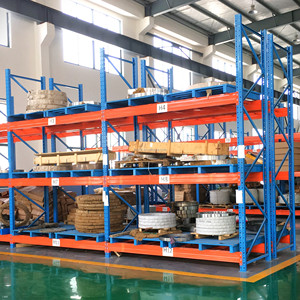
In modern industrial intra-logistics, Gravity Flow Pallet Racking Systems (commonly termed Pallet Flow Racks) represent the pinnacle of dynamic, ultra-high-density storage technology. Operating entirely on gravity-assisted kinetic principles, these systems utilize inclined wheel or roller beds set at precise pitch angles—typically between 3.5% and 4.5% gradient drop—to move loaded pallets seamlessly from an entry (loading) lane to an exit (unloading) lane. This creates an uncompromised First-In, First-Out (FIFO) inventory rotation model essential for perishable goods, cold-chain operations, pharmaceutical distribution, and high-velocity fast-moving consumer goods (FMCG) warehouses.
As a premiere OEM/ODM Gravity Flow Pallet Racking Supplier, our engineering department designs custom flow lanes based on structural steel roll-forming compliance standards (ANSI/RMI MH16.1 and European FEM 10.2.02). The structural dynamic relies on four key mechanical sub-assemblies:
Full-Width Steel Roller Track
Heavy-duty, precision ball-bearing steel rollers engineered to minimize rolling friction while withstanding shock loads during pallet placement.
Indirect Dynamic Speed Controllers
Centrifugal magnetic brake rollers installed at targeted intervals along the lane to maintain a uniform terminal velocity (0.2m/s–0.3m/s), preventing runaway collisions.
Mechanical Pallet Separators
Safety latching mechanisms at the discharge end that relieve accumulation line pressure between the lead pallet and trailing pallets, allowing safe forklift extraction.
By eliminating internal aisle space required by standard selective pallet racks, gravity flow configurations increase cubic storage capacity by up to 60% while reducing forklift travel distances, fuel/battery consumption, and labor hours per pallet turn.
OEM & ODM Engineering Customization Framework for Global Procurement
Direct sourcing from an established OEM/ODM Gravity Flow Pallet Racking Supplier provides enterprise procurement directors and system integrators with unparalleled customization flexibility. Warehouse logistics setups vary wildly in terms of building clear heights, floor slab load thresholds, unit load dimensions, temperature environments, and seismic zone requirements.
1. Tailored Steel Grade & Surface Metallurgical Specs
Our OEM manufacturing lines utilize prime structural steel coil feeds including high-yield Q235B and Q355B cold-rolled steel grades. For standard ambient temperature distribution centers, electrostatic epoxy powder coating (60–80 micron thickness) delivers exceptional impact and abrasion resistance. For sub-zero cold storage facilities operating down to -30°C, hot-dip galvanizing per ISO 1461 standards guarantees lifelong corrosion protection without zinc flaking.
2. Roller Track Pitch & Capacity Engineering
Pallet bottom configurations (e.g., 9-block wooden pallets, perimeter-base plastic pallets, or heavy metal skids) dictate roller spacing and wheel track geometry. Our ODM services engineer customized roller pitches ranging from 50mm to 150mm centers, capable of carrying unit loads from light 300kg cartoned goods up to 2500kg heavy industrial metal castings.
| Storage Racking System | Space Utilization | Stock Rotation Method | Selectivity Rate | Forklift Operating Risk | Capital ROI Horizon |
|---|---|---|---|---|---|
| Gravity Flow Racking | 85% - 90% (Highest) | 100% FIFO (First-In First-Out) | High per Lane / SKU | Very Low (External Stacking Only) | 12 - 18 Months |
| Selective Pallet Racking | 35% - 40% (Standard) | FIFO or LIFO | 100% Direct Access | Moderate (Deep Aisle Travel) | 24 - 36 Months |
| Drive-In Racking | 65% - 75% (High) | 100% LIFO (Last-In First-Out) | Low per Tunnel | High (Forklift Enters Frame) | 18 - 24 Months |
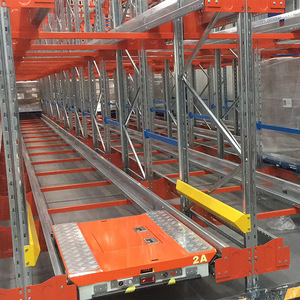
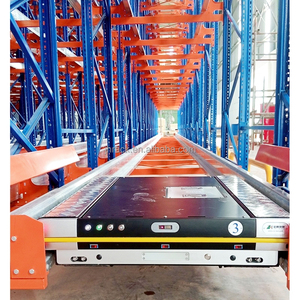
| Radio Shuttle Racking | 80% - 85% (High) | Flexible (FIFO / LIFO) | High per Channel | Low (Automated Shuttle) | 18 - 30 Months |
Future Procurement Trends & Technological Innovations in Dynamic Racking (2025–2030)
As global supply chains shift toward automated warehousing, high-density storage hardware must evolve to interface cleanly with Autonomous Mobile Robots (AMRs), Automated Guided Vehicles (AGVs), and Automated Storage and Retrieval Systems (AS/RS). Procurement teams searching for top-tier Gravity Flow Pallet Racking Suppliers must evaluate how prospective systems incorporate next-generation technological advancements:
1. AGV/AMR-Compatible Flow Lane End-Stops
Traditional gravity flow tracks rely on standard forklift tines to lift pallets over rigid end-stops. Future-ready dynamic flow lanes feature pneumatic or mechanical low-profile drop-stops. These allow precision AGV forks and robotic under-ride shuttles to seamlessly retrieve pallets without mechanical interference or sensor misalignment.
2. IoT Sensor Integration & Real-Time Track Monitoring
Smart dynamic flow tracks are now equipped with passive micro-sensors along the brake rollers. These sensors monitor lane velocity, detect pallet jams or uneven weight distribution, and transmit real-time telemetry to the warehouse management system (WMS). This predictive maintenance capability alerts floor supervisors to worn brake controllers before operational stoppages occur.
3. Eco-Efficient Cold-Chain Optimization
Cold storage facility energy costs scale directly with cubic building volume. Gravity flow racking eliminates cold air circulation pockets found in wide-aisle storage, drastically lowering energy consumption per stored pallet position. Procurement strategies in the food and beverage industry are heavily prioritizing high-density dynamic flow lanes to fulfill ESG (Environmental, Social, and Governance) sustainability mandates.
Enterprise Manufacturing Competencies & Quality Assurance
IronMax Storage Solutions Co., Ltd. operates a specialized production base in Shandong, China, spanning state-of-the-art manufacturing infrastructure tailored for heavy-duty structural rack fabrication. As a certified global OEM/ODM manufacturer, our operation is built on four core operational pillars:
Automated Roll-Forming Lines
Multi-stage continuous cold roll-forming machines guarantee structural upright profile tolerances within ±0.5mm, delivering exceptional frame alignment across tall bays.
Robotic Precision Welding
Automated robotic MIG welding arms execute complete penetration beam-connector welds, rigorously tested via Ultrasonic Flaw Detection to eliminate structural fatigue risks.
Full Traceability & Certification
Every raw steel heat number, powder batch code, and load test certificate is archived under ISO9001 quality systems, ensuring compliance with global safety standards.
Frequently Asked Questions (FAQ) for Dynamic Racking Procurement
For standard GMA or Euro-wooden pallets carrying 800kg to 1200kg unit loads, a pitch slope of 3.5% to 4.0% (approx. 7/16" drop per foot) is mathematically optimal. Thinner or flexible plastic pallets may require up to a 4.5% gradient paired with full-width steel rollers to prevent track deflection.
Speed controllers incorporate internal planetary gearboxes linked to magnetic braking shoes. As a pallet rolls over the controller roller, the angular speed forces the brake shoes outward against an internal housing wall. This dynamic friction opposes acceleration, ensuring the pallet maintains a safe, consistent velocity regardless of lane length.
Gravity flow lanes rely on continuous flat contact surfaces. Broken bottom runners, protruding nails, or sagging plastic bases can catch on roller gaps or cause hang-ups. For operations handling mixed or non-standard pallets, slave boards or specialized triple-track wheel configurations should be specified during the ODM phase.
While lanes can theoretically extend up to 20 pallets deep, optimal operational efficiency is achieved between 4 to 12 pallets deep. Deeper lanes require heavy-duty safety separators to manage accumulated line pressure (which can exceed several tons) at the discharge end.
Structural upright frames and beam sections are strapped into rigid wood-framed bundles with corner edge protectors. Roller beds and delicate speed controllers are sea-worthy packed in heavy wooden crates with vapor corrosion inhibitor (VCI) shrink wrap to prevent moisture oxidation during transit.
Optimize Your Warehouse Footprint with OEM/ODM Experts
Connect with our senior logistics engineers today. Submit your warehouse floor plans, pallet specifications, and throughput targets for a complimentary CAD layout and load calculation proposal.
Contact Us