Engineering Product Series
Heavy-duty, precision-rolled OEM/ODM warehouse storage systems compliant with international FEM, RMI, and AS4084 structural safety standards.
OEM/ODM Manufacturing Infrastructure & Technical Capabilities
Why leading global logistics hubs, 3PL providers, and industrial distributors source directly from our certified Chinese manufacturing base.
Boltless Interlocking Connection
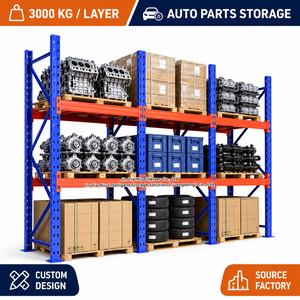
Engineered with proprietary teardrop and diamond-slot connection geometries that allow tool-free, high-rigidity beam-to-upright engagement. Reduces on-site installation time by up to 65% while maintaining structural rigidity under heavy dynamic loading.
High-Tensile Q235B / Q355B Steel
We source prime cold-rolled steel coils exclusively from premier steel mills. Material yield strengths are verified via rigorous finite element analysis (FEA) to ensure load capacities ranging from 500 kg to 5,000 kg per beam level with safety factors compliant with ANSI MH16.1.
Advanced Surface Treatment
Our fully automated 9-stage pre-treatment wash system is followed by thermosetting epoxy-polyester powder coating (60–80 μm thickness) or hot-dip galvanizing (ISO 1461), offering superior scratch, chemical, and humidity resistance in ambient and cold-storage facilities.
Comprehensive Industry Guide: Structural Physics and Metallurgy of Boltless Racking Systems
In modern industrial logistics, storage efficiency directly dictates operational profit margins. Boltless pallet racking—often designated as clip-in, tear-drop, or quick-assembly racking—represents a critical evolution in structural engineering over traditional bolted frame assemblies. By eliminating hardware fasteners along beam-to-frame connections, boltless architecture relies on tapered lug connectors engaging with precision-punched column slots. Under gravitational payload force, these connectors wedge deeper into the upright profile, creating a self-locking mechanism that increases moment resistance as storage weight scales.
Information Gain Insight: Structural analysis demonstrates that cold roll-formed upright profiles utilizing multi-bend column geometries (e.g., 11-fold or 13-fold profile cross-sections) exhibit a 28% higher torsional resistance compared to standard 8-fold profiles of equivalent wall thickness. When evaluating OEM suppliers, engineering buyers must verify section modulus and moment of inertia rather than steel gauge alone.
OEM vs. ODM Customization Engineering for Global Exporters
Procuring industrial storage equipment directly from Chinese manufacturing centers requires a rigorous understanding of the distinction between Original Equipment Manufacturing (OEM) and Original Design Manufacturing (ODM) workflows:
- OEM Services: Execution based strictly on client-provided architectural CAD drawings, structural specifications, and specific brand colors. Precision cold-roll tooling ensures tolerance matching down to ±0.5mm across 12-meter continuous upright columns.
- ODM Services: End-to-end engineering wherein our structural engineering team calculates building floor loading, clear ceiling height clearance, forklift turning radius, and seismic zone factors to present complete CAD/BIM operational layouts alongside structural load capacity calculations.
For international supply chain buyers, selecting an exporter with dedicated FEA (Finite Element Analysis) capabilities prevents structural over-engineering—saving material cost and ocean freight freightage—while eliminating structural failure risks in high-seismic zones.
Future Purchasing & Market Trends in Global Warehouse Storage (2025–2030)
The global industrial racking market is undergoing rapid technological restructuring driven by automated logistics, green building mandates, and nearshoring trends. Procurement managers must position their supply chains to leverage four primary shifts:
1. Integration of Automated Storage and Retrieval Systems (AS/RS) and AMRs
Traditional static storage is increasingly being converted to semi-automated and fully automated platforms. Pallet racking frames are now engineered with tighter tolerances to accommodate high-speed Radio Shuttle carts and Autonomous Mobile Robots (AMRs). Upright columns must integrate laser-guided sensor positioning track holes, and beam deflections must be strictly capped at L/300 to prevent automated shuttle jamming during high-bay retrieval operations.
2. Transition to Eco-Friendly Coatings and Sustainable Galvanizing
Global ESG (Environmental, Social, and Governance) compliance is driving demand for zero-VOC, heavy-metal-free electrostatic powder finishes. Furthermore, facilities operating in humid environments or cold-chain storage are transitioning from traditional zinc-chromate plating to pre-galvanized high-yield steel coils and eco-friendly hot-dip galvanizing compliant with EU REACH directives.
3. Modular and Reconfigurable Heavy-Duty Floor Platforms
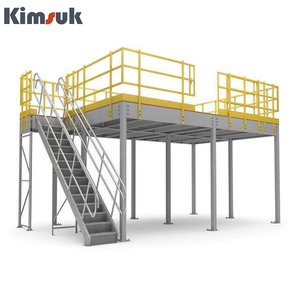
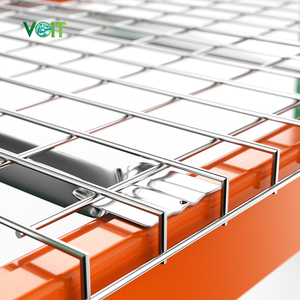
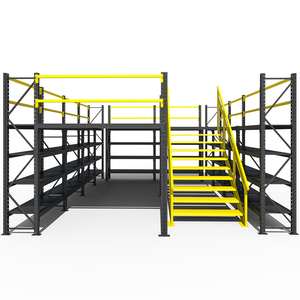
Flexibility is paramount for fast-growing e-commerce operations. Modern procurement strategies favor steel structure mezzanine platforms and multi-tier boltless racking modules that allow vertical expansion without structural footprint expansion. These systems use structural steel beams paired with corrugated zinc steel decking or wire mesh decks to meet fire sprinkler penetration rules (NFPA 13 standards).
Technical Matrix: Warehouse Racking Structural Systems
Comparative structural engineering matrix to assist logistics directors and procurement engineers in selecting the optimal boltless storage platform.
| Racking System Type | Load Capacity / Level | Pallet Selectivity | Aisle Width Requirement | Floor Space Utilization | Optimal Application |
|---|---|---|---|---|---|
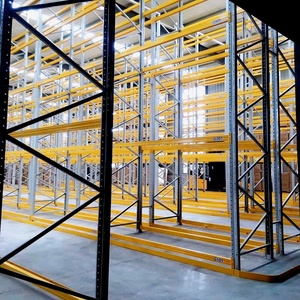
| Selective Boltless Pallet Racking | 500 kg – 4,000 kg | 100% Direct | 3.0m – 3.8m (Standard Forklift) | 35% – 40% | High SKU diversity, FMCG, general distribution centers |
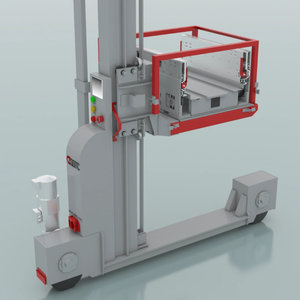
| Very Narrow Aisle (VNA) Systems | 1,000 kg – 2,500 kg | 100% Direct | 1.5m – 1.8m (VNA Turret Truck) | 60% – 75% | High-density logistics hubs with maximum vertical space |
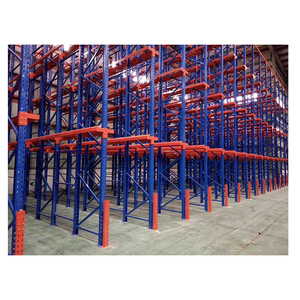
| Drive-In / Drive-Thru Racking | 500 kg – 2,000 kg | Low (LIFO / FIFO) | Eliminates inner aisles | 75% – 85% | Homogeneous bulk goods, seasonal products, cold storage |
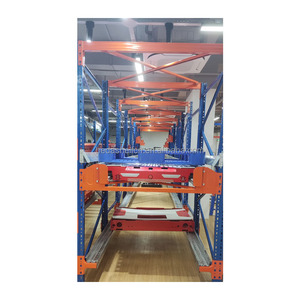
| Radio Shuttle Automation Racking | 500 kg – 2,500 kg | Medium (Per Lane LIFO/FIFO) | Dedicated shuttle channel | 85% – 90% | Deep lane cold chain storage, food & beverage logistics |
| Heavy Duty Mezzanine Platform | 300 kg – 1,500 kg / sqm | Flexible Pick Faces | Custom Layout | 200% – 300% (Vertical Multi-Tier) | E-commerce fulfillment centers, spare parts inventory |
Frequently Asked Questions (FAQ)
Clear, engineering-backed answers addressing the most common technical and logistics inquiries from international industrial racking buyers.
What load safety factor is engineered into your boltless pallet racking columns and beams?
Our structural designs adhere strictly to RMI (Rack Manufacturers Institute) and FEM 10.2.02 standards. All structural capacity ratings incorporate a minimum safety factor of 1.5 to 1.94 for steel yield stress. Structural calculations account for dynamic impact loads, dead loads, and regional seismic coefficients. Full material test certificates (MTC) according to EN 10204 3.1 are provided with every factory shipment.
How do boltless tear-drop connection systems prevent accidental beam displacement during forklift operations?
Each beam end connector is equipped with an automatic spring-loaded steel safety lock pin or heavy-duty snap lock clip. When the beam lug engages the tapered column slot, the lock pin automatically snaps into place, requiring a manual upward force exceeding 750 kg to disengage. This prevents accidental dislodgements caused by upward forklift driver error.
Can your engineering team assist with custom OEM sizing and seismic layout approval?
Yes. Our in-house structural engineering department provides complimentary AutoCAD layout design, 3D BIM structural modeling, and complete finite element analysis calculations. We routinely customize beam spans, column section profiles, base plate anchoring configurations, and frame bracing ratios to comply with specific local building codes, seismic zones (PGA ratings up to 0.4g), and rack safety mandates worldwide.
What surface treatment is recommended for sub-zero freezer cold storage environments?
For sub-zero freezers (-25°C to -40°C), we recommend either hot-dip galvanizing (HDG) conforming to ISO 1461 with a minimum zinc thickness of 65–85 μm or specialized low-temperature epoxy powder coatings applied over a zinc-rich primer. Hot-dip galvanizing provides self-healing cathodic protection against micro-scratches, moisture condensation, and rust formation caused by thermal cycling.
How are large-scale OEM racking components packaged to prevent damage during ocean container transport?
Upright columns and structural beams are bundled using heavy-duty steel strapping, protective corner edge guards, and multi-layer plastic stretch wrap. Steel frames are elevated on custom wooden or steel runners for rapid forklift loading/unloading. Small hardware accessories, wire mesh deck clips, baseplates, and safety pins are export-packed in reinforced wooden crates or heavy-duty triple-wall corrugated cartons to eliminate transit friction and finish abrasion.
What is the lead time for custom OEM manufacturing and container export orders?
Standard lead time for customized OEM manufacturing is typically 15 to 25 business days from CAD drawing sign-off and deposit receipt. Our factory operates continuous automated cold-roll lines capable of processing over 3,000 metric tons of steel per month, ensuring reliable on-time container vessel departures for high-volume turnkey projects.
Request Engineering Support & OEM Factory Pricing
Partner directly with a certified Chinese racking manufacturer. Our structural engineering team is ready to analyze your warehouse floor plans and deliver optimized structural drawings and quote breakdowns within 24 hours.