Core Warehouse Storage Products
Precision-engineered, heavy-duty racking systems, automated shuttles, and industrial pallets manufactured to international standards.
Whitepaper: Engineering Paradigm of Modern Chinese Warehouse Racking Manufacturing
As global supply chains face unprecedented pressure to maximize volumetric utilization, reduce footprint costs, and accelerate order execution speed, warehouse storage rack system engineering has transitioned from passive structural steel framing into a highly calculated, multi-disciplinary science. As China's leading factory direct supplier and exporter, IronMax Storage Solutions Co., Ltd. (headquartered in Shandong Province) delivers heavy-duty pallet racking systems designed to withstand stringent dynamic load demands, seismic forces, and high-frequency Material Handling Equipment (MHE) impacts.
Modern warehouse logistics require an optimal balance between Storage Density (cubic space optimization) and SKU Selectivity (immediate pallet access). Choosing an inadequate storage frame design leads to structural sagging, frame fatigue, and elevated operational risks. IronMax integrates high-grade cold-rolled structural steel (Q235B and Q355B grades) with proprietary continuous roll-forming technology, producing upright posts with 75mm or 50mm pitch tear-drop and omega profiles capable of carrying static frame loads up to 24,000 kg.
Technical Insight: Structural integrity begins at steel chemistry. Cold-rolled Q355B structural steel offers a minimum yield strength of 355 MPa, providing a 35% safety margin over standard mild steel profiles. This allows for lighter component deadweight without compromising beam deflection ratios ($L/200$ limits under maximum rated capacity).
Structural Anatomy of Heavy-Duty Heavy Load Pallet Racking
Industrial selective and high-density racking systems engineered by IronMax consist of six critical structural sub-assemblies:
- Upright Frames: Formed via 18-stage cold roll-forming machines with double-ribbed return bends. Bracing trusses are arranged in triangulated geometry using K-type or Z-type bracing to resist lateral sway and torsional vibration.
- Box Beams & Step Beams: Fabricated from two C-profile steel channels seam-welded in automated robotic welding cells. Beam connectors feature 3 to 5 heavy-duty steel hooks with automatic safety locks to prevent accidental forklift dislodgement.
- Wire Mesh Decking & Pallet Supports: Engineered for overhead protection and distribution of point loads from irregular or damaged wooden/plastic pallets.
- Column Protectors & Frame Guards: Heavy-gauge floor-anchored steel guards equipped with rubber shock absorbers to mitigate fork truck impact damage at aisle intersections.
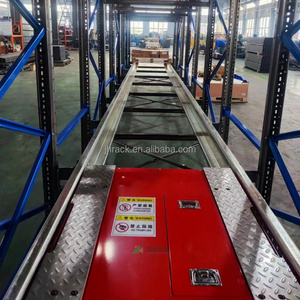
- Radio Shuttle Rails & Pallet Guides: Precision-extruded galvanized steel tracks designed for autonomous battery-operated shuttle carts moving at speeds up to 1.2 m/s.
- Baseplates & Anchor Bolts: Structural shim plates and chemical anchor bolts calculated specifically for local ground slab thickness and soil bearing capacity.
Pallet Storage System Selection Matrix
Evaluate storage technologies against operational parameters, warehouse footprint, and handling machinery.
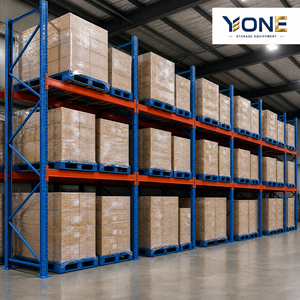
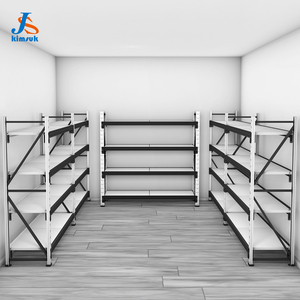
Selective Pallet Racking
100% SKU Selectivity | 500–4,000 kg/level
The benchmark for general warehousing. Allows direct access to every single pallet location using standard counterbalance or reach trucks. Ideal for high-SKU, fast-moving consumer goods (FMCG) and third-party logistics (3PL) fulfillment centers.
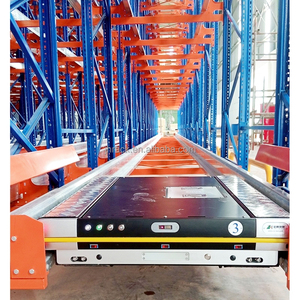
Radio Shuttle Racking
Semi-Automated High Density | LIFO / FIFO Flow
Uses autonomous battery-powered shuttle vehicles running on internal rails to deposit and retrieve pallets. Minimizes forklift drive-in requirements, drastically reducing rack damage while maximizing cold storage volumetric density.
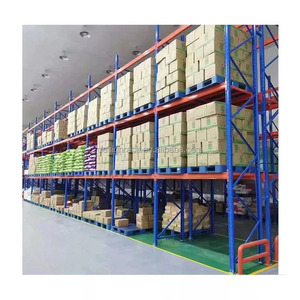
Push Back Racking Systems
2 to 6 Pallets Deep | LIFO Management
Nested wheeled carts slide on inclined structural channels. When a new pallet is loaded, it pushes existing pallets backward. Offers higher density than selective racking with faster load cycles than drive-in systems.
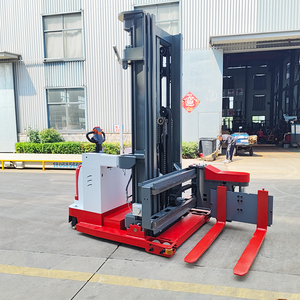
Very Narrow Aisle (VNA)
Max Space Utilization | Up to 17m Heights
Reduces aisle width down to 1.5m–1.8m by utilizing wire-guided or rail-guided VNA turret trucks. Reclaims up to 40% of floor space compared to conventional selective setups without sacrificing 100% pallet access.
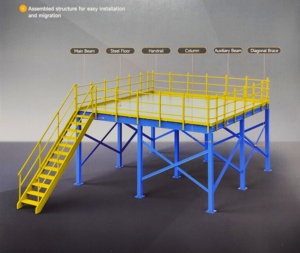
Industrial Mezzanine Racks
Vertical Cubic Doubling | Heavy Floor Loads
Utilizes heavy-duty rack columns to support integrated multi-tier steel floors. Multiplies usable floor space by 200%–300% without structural building expansion, perfect for e-commerce picking and spare parts inventory.
Cantilever Heavy-Duty Racks
Unobstructed Front Access | Long Goods
Eliminates front structural columns to accommodate long, bulky, or awkward materials such as steel pipes, timber packs, aluminum extrusions, and sheet metals with single or double-sided arms.
Engineering Comparison Table: System Capabilities & Performance Metrics
Before issuing a Request for Quotation (RFQ), procurement directors and supply chain engineers must evaluate trade-offs across density, selectivity, throughput speed, and capital expense (CapEx).
| Racking Architecture | Volumetric Efficiency | Pallet Access (Selectivity) | Forklift Aisle Requirement | Stock Flow Logic | Relative CapEx / Pallet |
|---|---|---|---|---|---|
| Selective Pallet Racking | 40% - 50% | 100% (Immediate) | 3.0m - 3.5m | FIFO / LIFO | Economy (Baseline) |
| Drive-In Racking | 65% - 75% | 20% - 30% (Batch) | Drive-in Lanes | LIFO Strictly | Low - Medium |
| Push Back Racking | 60% - 70% | 40% - 50% (Per Lane) | 2.8m - 3.2m | LIFO Strictly | Moderate |
| Very Narrow Aisle (VNA) | 70% - 80% | 100% (Immediate) | 1.5m - 1.8m | FIFO / LIFO | Medium - High |
| Radio Shuttle System | 80% - 90% | 50% - 60% (Per Channel) | 2.8m - 3.0m | FIFO & LIFO Dual | High (Automated) |
| Multi-Tier Mezzanine Floor | 150% - 250% (Cubic) | 100% Manual/Picked | N/A (Pedestrian/Trolley) | FIFO / Order Pick | Medium - High |
Global Sourcing Trends & Industrial Development Trajectory (2025–2030)
1. Automated Storage & Retrieval System (AS/RS) & Shuttle Convergence
The global warehousing industry is rapidly moving away from purely manual, driver-dependent fork truck handling toward semi-automated and fully automated architectures. Four-Way Radio Shuttle Racking systems are replacing traditional drive-in racks. Modern shuttle vehicles utilize advanced lithium-iron-phosphate ($LiFePO_4$) battery technology and optical sensor arrays, executing vertical lane changes and multi-channel pallet transfers controlled via WMS (Warehouse Management System) software via Wi-Fi 6 networks.
2. Advanced Surface Treatment & Corrosion Resistance in Cold Chain Logistics
Cold storage facilities operate under severe thermal condensation cycles, accelerating structural oxidation. Sourcing trends favor dual surface protection technologies:
- Thermosetting Epoxy Powder Coating: 80–120 micron electrostatically applied powder cured at 200°C, providing superior abrasion resistance against forklift tines.
- Continuous Pre-Galvanized & Hot-Dip Galvanized (HDG): Zinc coatings yielding 275 g/m² to 600 g/m² coverage for sub-zero freezer environments (-30°C) and aggressive high-humidity chemical storage facilities.
3. Seismic Resilience & FEM 10.2.02 Structural Compliance
Tier-1 industrial warehouse EPC contractors require certified seismic calculations. Chinese exporters must provide finite element analysis (FEA) demonstrating rack stability under dynamic ground acceleration. IronMax designs structures adhering to European FEM 10.2.02 standards and American RMI (Rack Manufacturers Institute) specifications, ensuring cross-aisle and down-aisle structural safety under Zone 4 earthquake conditions.
4. Sustainable Sourcing & Total Cost of Ownership (TCO) Optimization
B2B buyers prioritize Total Cost of Ownership rather than landed FOB price alone. Structural longevity, modular expanding capability, zero-maintenance galvanization, and low damage rates directly contribute to a lower long-term cost per pallet slot over a 15-to-20-year operational lifecycle.
Why Global Importers & EPC Contractors Choose IronMax
Direct manufacturer capabilities headquartered in Shandong, China—engineered for reliability, speed, and safety.
Direct Factory Manufacturing Base
Located in Jining City, Shandong Province, IronMax operates state-of-the-art cold roll-forming lines, automated laser tube cutters, and robotic welding stations. By keeping 100% of manufacturing in-house, we eliminate broker markups and maintain rigorous batch-to-batch structural tolerance control.
Engineering CAD & Structural Calculations
Our staff of 120+ skilled engineers and logistics planners offers complimentary CAD space planning, 3D structural modeling, and floor load weight analysis tailored precisely to your building heights, column grids, and handling equipment specs.
Traceable ISO & CE Quality Control
Every steel coil undergoes chemical analysis and yield strength testing upon arrival. Weld seams undergo non-destructive ultrasonic inspections, and powder coating adhesion is verified via cross-hatch testing to guarantee zero coating peel under demanding industrial conditions.
Export Logistics & Installation Guidance
Racking components are bundled with steel strapping, corner protectors, and moisture-proof plastic wrapping designed for long sea freight transit. Orders ship with complete installation drawings, component identification numbers, and remote engineer video support.
Frequently Asked Questions (FAQ) for Global Buyers
Authoritative technical answers to common queries raised by warehouse managers, supply chain engineers, and procurement specialists.
What maximum load capacities can IronMax heavy-duty pallet racking support?
Standard selective pallet racking systems support load capacities ranging from 500 kg to 4,000 kg per beam level (2,000 kg per pallet position). Heavy-duty push back racking and specialized mold storage racks can support up to 5,000 kg per level. Upright frame loading capacities exceed 24,000 kg depending on beam elevation and vertical tie bracing spacing.
Should I select epoxy powder coating or galvanized finishes for my racking project?
Powder coating is ideal for standard ambient-temperature dry indoor warehouses, offering cost efficiency, high chemical resistance, and customizable brand colors (such as RAL 5015 Blue and RAL 2004 Orange). Galvanized finishes (pre-galvanized or hot-dip galvanized) are mandatory for cold storage freezers, outdoor rack-clad structures, and humid or coastal environments to eliminate rust risk.
How does IronMax assist in designing a custom warehouse storage layout?
Simply provide your building CAD architectural drawing or dimensions (length, width, clear ceiling height), pallet footprint ($W \times D \times H$), unit load weight, and forklift specs (lift height and minimum right-angle stack aisle width). Our engineering team generates a comprehensive 2D layout layout proposal and 3D rendering within 24 hours, complete with dynamic load calculations.
What international safety and manufacturing standards do IronMax products comply with?
All IronMax storage systems are manufactured in full compliance with European FEM 10.2.02 (Design of Static Steel Pallet Racking), EN 15512, ANSI/RMI MH16.1 specifications, and ISO 9001:2015 quality management benchmarks, ensuring seamless sign-off by local safety inspectors worldwide.
Which pallet storage system is most cost-effective for cold storage facilities?
Because cold room construction and refrigeration operational expenses are extremely high per cubic meter, high-density systems such as Drive-In Racking or Radio Shuttle Racking are recommended. Radio Shuttle systems achieve up to 85% volume utilization while keeping forklift trucks outside the freezer room, preserving battery life and reducing thermal loss.
How are export shipments packed to prevent freight damage during ocean transit?
Racking uprights and beams are bundled using heavy-duty steel strapping over protective corrugated cardboard edge protectors. Small accessories, baseplates, bolts, and clips are packed into heavy-duty reinforced wooden crates or double-wall export cartons. Loading plans are calculated via 3D software to optimize container volume usage (20GP / 40HQ) and ensure safe unloading with standard forklifts.
Ready to Optimize Your Warehouse Storage Capacity?
Connect with IronMax Senior Storage Engineers today. Receive a customized 2D/3D layout proposal, exact structural load calculation, and competitive factory-direct pricing within 24 hours.