Executive Summary: Navigating Multi-Pallet Position Racking Dynamics
In modern global supply chain logistics, real estate acquisition costs and operational overhead have made warehouse floor optimization an essential strategic objective. Industrial logistics operators, cold storage facility planners, and third-party logistics (3PL) providers are increasingly forced to migrate away from conventional single-deep selective racking to Multi Pallet Position Racking Systems. These high-density configurations—encompassing Double-Deep Racking, Push-Back Cart Systems, Drive-In / Drive-Through Blocks, Radio Shuttle Satellites, and Very Narrow Aisle (VNA) Multi-Depth Systems—dramatically increase cubic storage density while minimizing aisle waste.
As China’s leading manufacturer and global exporter of industrial storage solutions, IronMax Storage Solutions Co., Ltd. engineered this whitepaper to provide supply chain directors, industrial procurement managers, and logistics consultants with an empirical framework for evaluating, specifying, and sourcing multi-pallet racking infrastructure directly from China.
Information Gain Metric: Standard selective racking yields a volumetric space efficiency of only 35% to 45% due to excessive forklift aisle requirements. Implementing multi-pallet position configurations elevates space utilization to between 65% and 85%, directly reducing storage cost per pallet position by up to 38% over a 10-year facility lifecycle.
1. Structural Anatomy & Engineering Physics of High-Density Racking
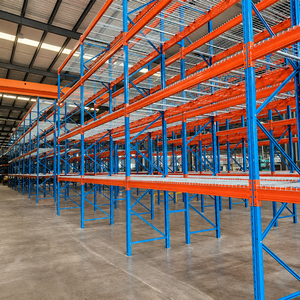
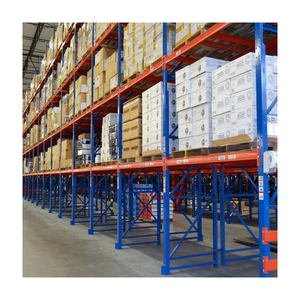
Multi-pallet position racking systems are subjected to severe static loading, dynamic forklift impacts, and potential seismic accelerations. IronMax engineered systems utilize premium cold-rolled structural carbon steel (Q235B and high-yield Q355B), precision roll-formed into modified teardrop or 13-fold profile upright columns.
Key Structural Components & Metallurgy Metrics:
- Cold-Rolled Upright Frames: Formed via continuous multi-stage rolling mills to guarantee uniform cross-sectional thickness (1.8mm to 3.0mm). Column profiles incorporate 75mm or 50mm pitch adjustment slots, allowing customizable beam elevations.
- Heavy-Duty Box Beams & Step Beams: Fabricated by seam-welding two interlocking C-sections or roll-formed step profiles. Beam connectors feature 3 to 5 heavy-gauge claw hooks with automatic spring-loaded safety locks to eliminate accidental dislodgements under high-reach forklift operation.
- Horizontal & Diagonal Bracing Trusses: Engineered with bolted tubular structural webbing to resist frame sway and torsional buckling under extreme multi-tier loading.
- Floor Anchoring & Baseplates: Heavy-gauge structural baseplates anchored into reinforced concrete slabs via expansion or chemical anchor bolts, transferring vertical compression and overturning moments safely to the foundation.
Q355B Steel Advantage
High-yield tensile strength allows thinner material profiles with equal or superior load ratings, decreasing dead weight while increasing structural safety factors (1.65 to 1.95 ratio).
Advanced Surface Finish
Automated 9-stage pre-treatment cleaning followed by electrostatic epoxy-polyester powder coating (80–120 microns) or Hot-Dip Galvanizing (HDG) for corrosive cold-chain environments.
Finite Element Analysis
Every custom installation is subjected to ANSYS FEA simulations to verify horizontal deflection ratios under EN 15512 and ANSI MH16.1 structural standards.
2. Categorization of Multi Pallet Position Systems
Different operational paradigms require different balances between pallet accessibility (selectivity) and storage density. Below is an engineering breakdown of the core multi-depth modalities manufactured by IronMax:
A. Double-Deep Selective Racking (2-Position Depth)
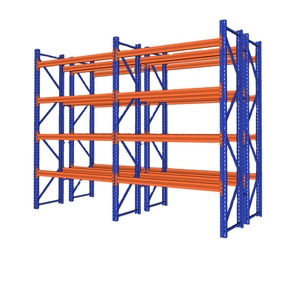
By placing two rows of standard selective racking back-to-back, Double-Deep systems store pallets two-deep per aisle face. This eliminates 50% of the access aisles required in standard selective configurations. Operation requires pantograph extended-reach forklifts or deep-reach attachments. It represents an ideal compromise for medium-SKU operations requiring Last-In, First-Out (LIFO) or paired batch inventory rotation.
B. Push-Back Cart & Roller Systems (2 to 6-Position Depth)
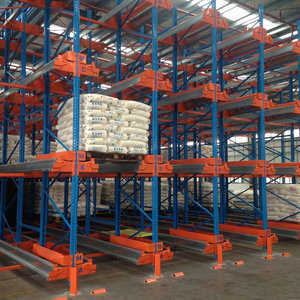
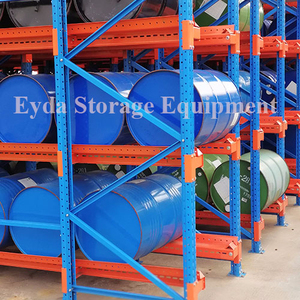
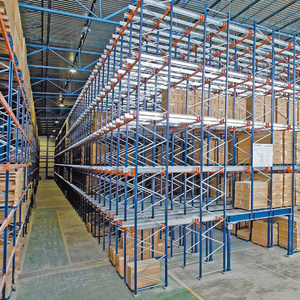
Push-Back systems utilize nested wheel carts moving along inclined structural steel rails. As a forklift loads the first pallet onto the top cart, placing the second pallet pushes the first pallet back one position. When retrieving, gravity gently feeds the remaining pallets forward to the aisle face. This mechanism operates entirely on mechanical physics without electrical automation, guaranteeing exceptional durability in high-throughput distribution hubs.
C. Radio Shuttle Semi-Automated Systems (Multi-Depth Unlimited)
Radio Shuttle racking represents the pinnacle of modern semi-automated multi-position storage. An autonomous battery-powered shuttle platform (satellite car) runs inside specialized guide rails within dense racking channels. Wireless RF remote controls or warehouse management system (WMS) integration direct the shuttle to transport pallets deep into the lane. This system eliminates forklift entry into the rack structure, drastically improving cycle times and structural longevity.
D. Drive-In & Drive-Through High-Density Systems
Designed for homogeneous bulk cargo and long-term storage, Drive-In systems allow forklifts to enter the racking bays directly along continuous support rails. By removing cross-beams between uprights, pallets are stacked along continuous depth channels. Drive-Through configurations offer entry at both ends, supporting First-In, First-Out (FIFO) stock management.