1. Technical Fundamentals of LIFO Pallet Racking in Modern High-Density Warehousing
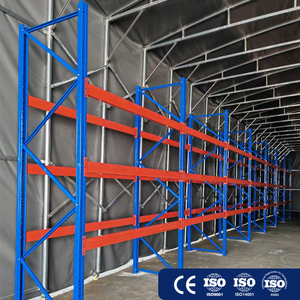
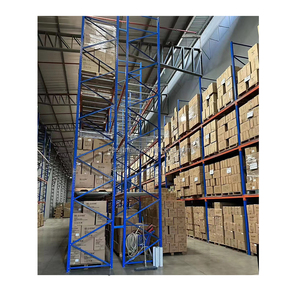
In global supply chain architecture and modern warehouse material handling, volume optimization while preserving structural integrity represents the primary engineering objective. Last-In, First-Out (LIFO) pallet storage systems stand at the apex of high-density storage methodologies. Designed specifically for operations handling bulk, non-perishable inventory or high-volume SKUs with low turnover variation, LIFO racking minimizes unnecessary aisle access space, consolidating storage density by 60% to 85% over conventional Selective Pallet Racking configurations.
When procurement managers, logistics engineers, and warehouse directors search for the China Best LIFO Pallet Racking Manufacturers & Factories, evaluating candidate suppliers requires an in-depth understanding of the physics, structural steel mechanics, and manufacturing metallurgy driving these advanced storage structures. As a leading manufacturer operating out of China's primary industrial steel fabrication hubs, IronMax Storage Solutions Co., Ltd. (also recognized under factory registration as Jinghui Intelligent Warehousing Equipment Shandong Co., Ltd.) engineers custom LIFO configurations designed to withstand severe dynamic load stress, seismic forces, and high-frequency material handling operations.
Mechanics of LIFO Dynamics: Push-Back vs. Drive-In vs. Radio Shuttle
The term "LIFO" encompasses several distinct mechanical architectures. Selecting the optimal configuration requires analyzing the inventory profile, forklift fleet parameters, throughput targets, and capital expenditure constraints:
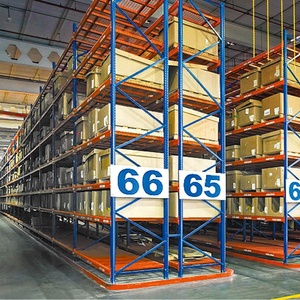
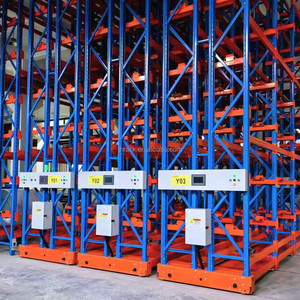
- Push-Back Pallet Racking (Telescoping Cart & Gravity Flow Systems): Push-Back racking utilizes nested, inclined cart channels. The first pallet is placed on the top cart by a forklift. When the second pallet is loaded, it physically pushes the first pallet back into the rack, revealing the second cart underneath. Depalletizing operates via gravity: when the front pallet is retrieved, remaining pallets slide forward automatically to the picking face. Push-back systems typically accommodate 2 to 6 pallets deep per lane.
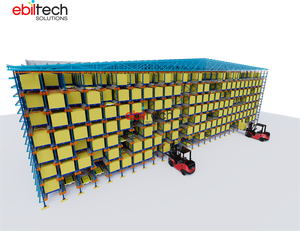
- Drive-In Pallet Racking (Continuous Channel Support): Drive-In racking eliminates inner aisles by allowing counterbalanced or reach forklifts to physically drive directly into the racking bays to place pallets on continuous side support rails (corbels). Because the forklift enters a single-ended channel, the last pallet stored on the rail is necessarily the first pallet retrieved. This system yields ultra-high density for deep lane storage (up to 10+ pallets deep).
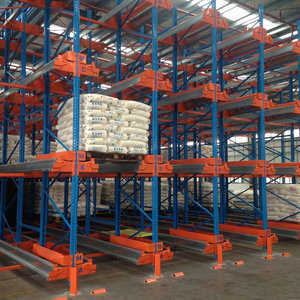
- Radio Shuttle LIFO Mode (Semi-Automated Deep Lane Racking): Integrating robotics with structural steel, Radio Shuttle systems utilize an autonomous motorized shuttle car running on tracks beneath the pallet rails. In LIFO operational mode, the shuttle deposits pallets sequentially into deep channels (up to 30+ pallets deep) and retrieves them from the single front aisle, eliminating forklift intrusion while multiplying throughput efficiency.
2. Engineering Metallurgy & Manufacturing Standards in Chinese Manufacturing Hubs
The structural safety of heavy-duty industrial racking hinges entirely on cold-formed steel engineering, dimensional precision during roll-forming, and metallurgical consistency. China's leading storage equipment factories utilize advanced steel grades combined with automated manufacturing to guarantee mechanical stability across multi-tier elevated racking systems.
Steel Coil Selection (Q235B / Q355B)
Structural members (upright columns, boxed beams, nested cart frames) are cold-rolled from certified structural steel. Q235B provides superior yield strength (~235 MPa) and ductility, while Q355B high-tensile steel is deployed for extreme heavy-duty elevated bay columns to prevent elastic buckling.
Continuous Roll-Forming & Tolerances
Our Shandong facility operates 18 continuous automated roll-forming lines. Upright profiles feature complex multi-ribbed profiles (up to 12-14 folds) to maximize the moment of inertia ($I_x, I_y$) and radius of gyration, ensuring compliance with FEM 10.2.02 and EN 15512 specifications.
Electrostatically Cured Powder Coating
Prior to coating, steel members undergo an 8-stage pre-treatment wash including degreasing, zinc-phosphating, and deionized water rinsing. Epoxy-polyester powder is electrostatically applied and cured at 200°C, yielding an 80-120 µm dry film thickness (DFT) resistant to impact, chemical abrasion, and humidity.
Finite Element Analysis (FEA) & Seismic Structural Engineering
Heavy-duty LIFO racking systems, particularly multi-deep Push-Back and high-bay Drive-In structures, experience complex eccentric dynamic forces during forklift loading and pallet push-back motion. Qualified Chinese manufacturers conduct full 3D Finite Element Analysis (FEA) to simulate strain distribution, beam deflection limits (strictly capped at $L/200$ under full safe working load), and global buckling behavior under dynamic seismic loading (compliant with AS4084, RMI, and EN standards).
3. Comprehensive Technical Sourcing Matrix: LIFO vs. Alternative Systems
To assist warehouse planners in determining whether LIFO Pallet Racking is the correct architectural choice for their logistics distribution facility, the following comparative engineering matrix highlights structural, financial, and operational trade-offs across storage configurations:
| Racking Architecture | Storage Density | Inventory Flow | Selectivity | Max Load per Level | Forklift Intrusion Risk | Relative CAPEX |
|---|---|---|---|---|---|---|
| Push-Back Racking | Very High (70-75%) | LIFO | Low (Per Lane) | Up to 5,000 kg | Zero (Aisle Operations Only) | Moderate - High |
| Drive-In Racking | Maximum (75-85%) | LIFO | Very Low | Up to 3,000 kg | High (Forklift Enters Bay) | Low - Moderate |
| Radio Shuttle System | Maximum (80-85%) | LIFO or FIFO | Medium (Per Lane) | Up to 2,000 kg/pallet | Zero (Shuttle Automated) | High (Robotics) |
| Selective Pallet Racking | Standard (40-45%) | FIFO / LIFO | 100% Direct Access | Up to 4,000 kg | Zero (Aisle Operations Only) | Low (Baseline) |
| Very Narrow Aisle (VNA) | High (60-65%) | FIFO / LIFO | 100% Direct Access | Up to 3,000 kg | Low (Guided Turret Truck) | Moderate |
4. Technology Trends Shaping Future LIFO Pallet Racking Procurement (2025–2030)
As global supply chains shift toward hyper-automation, cold-chain expansion, and carbon-neutral facility management, the procurement landscape for industrial pallet racking manufactured in China is undergoing significant technological upgrades. Strategic buyers are no longer evaluating structural steel purely as static iron; they are purchasing integrated logistics hardware engineered for future automation compatibility.
Trend 1: Hybrid Radio Shuttle LIFO Systems with AGV/AMR Integration
Traditional manually operated forklifts are increasingly being augmented or replaced by Autonomous Mobile Robots (AMRs) and Automated Guided Vehicles (AGVs). Next-generation LIFO Radio Shuttle racking systems manufactured by IronMax incorporate optical laser-alignment targets, RFID tracking plates, and automated charging stations integrated directly into the steel framing. This allows fleet management software (WMS/WCS) to coordinate AGVs to move shuttle vehicles across vertical lifts without human intervention.
Trend 2: Cold-Chain Optimization & Galvanized Sub-Zero Coating Advances
With global demand for frozen food and biopharmaceuticals surging, cold-storage warehouses operate at high energy costs. High-density LIFO systems (especially Push-Back and Shuttle channels) maximize cold air volume efficiency. To combat the severe corrosion caused by thermal condensation in sub-zero freezers (-30°C), modern Chinese manufacturing has transitioned toward continuous Hot-Dip Galvanizing (HDG) per EN ISO 1461 standards, providing a self-healing zinc-iron alloy coating that prevents structural degradation for decades.
Trend 3: Smart Sensor Structural Health Monitoring (IoT Racking)
Overloading, forklift impact damage to upright columns, and seismic tremors pose catastrophic safety risks in dense LIFO rack blocks. Emerging hardware trends include the integration of wireless IoT strain gauges, tilt sensors, and piezoelectric impact detectors mounted on critical rack frame joints. These sensors relay micro-deflection data to warehouse management dashboards, alerting safety compliance teams before structural fatigue leads to rack collapse.
Trend 4: Sustainable Green Steel & Low-Carbon Coating Formulations
Multinational enterprise buyers subject to Scope 3 carbon emission reporting now demand verified environmental product declarations (EPDs) from their Chinese supplier partners. Leading factories are utilizing green steel billets smelted using electric arc furnace (EAF) technology powered by renewable energy, paired with zero-VOC (Volatile Organic Compound) electrostatic powder formulations to drastically reduce the carbon footprint per installed pallet position.
5. Enterprise Advantages: Sourcing Heavy Industrial Racking from IronMax
Selecting IronMax Storage Solutions Co., Ltd. as your original equipment manufacturer (OEM) or turnkey project partner provides distinct engineering, financial, and logistical advantages for international procurement teams, EPC contractors, and rack distributors:
- Full Turnkey Custom Engineering: Our technical division handles the entire project lifecycle—from initial CAD floorplan analysis and load design to dynamic stress calculations, seismic engineering compliance, structural production, and export logistics planning.
- In-House Complete Manufacturing Chain: Unlike trading intermediaries, our factory controls cold-steel roll forming, automated robotic welding (compliant with AWS D1.1 standards), laser cutting, surface pre-treatment, and powder coating under one roof, guaranteeing batch-to-batch structural integrity.
- Strict QC Audits & Load Testing: Every production lot undergoes rigorous material testing, including steel yield stress verification, weld penetration ultrasonic inspections, coating adhesion cross-hatch tests, and full-scale beam deflection loading tests prior to packaging.
- Export Container Load Optimization: Upright frames and beams are systematically bundled using protective polyethylene wrapping, heavy-duty steel strapping, and wooden dunnage engineered to fit standard 40ft High Cube containers without wasting space or risking transit damage.
Need a Customized LIFO Racking Layout & Engineering Quotation?
Send your warehouse dimensions, pallet specifications, handling equipment details, and storage targets to our structural design team for a complimentary layout proposal within 24 hours.
Inquire Now