Warehouse space is costly, yet wide aisles can leave valuable floor area unused. For operations storing many pallets of similar products, that trade-off deserves a closer look. Drive-Through Pallet Racking uses parallel storage lanes that forklifts can enter from either end. Pallets move along rails, with loading at one end and retrieval at the other. Managed in this way, the system can support first-in, first-out stock rotation. It can also increase storage density compared with selective racking, which gives direct access to each pallet.
The case for denser storage sits within a wider shift toward warehouse efficiency. MHI and Deloitte’s 2024 Annual Industry Report found that 55% of surveyed supply-chain professionals expected to adopt robotics and automation within five years. That figure is not a forecast for racking demand. It does show that operational design and material flow are receiving serious attention. Still, higher density is not automatically better. Forklift turning space, pallet condition, lane depth, product mix, and replenishment timing all affect performance. A deep lane may save aisle space but slow access when stock varies. The details matter.
This guide examines where drive-through systems fit, what they require, and what to assess before installation. A practical layout starts with real pallet dimensions and daily movement data—not a neat drawing alone. Good design is specific. And sometimes, the best answer is a different rack.
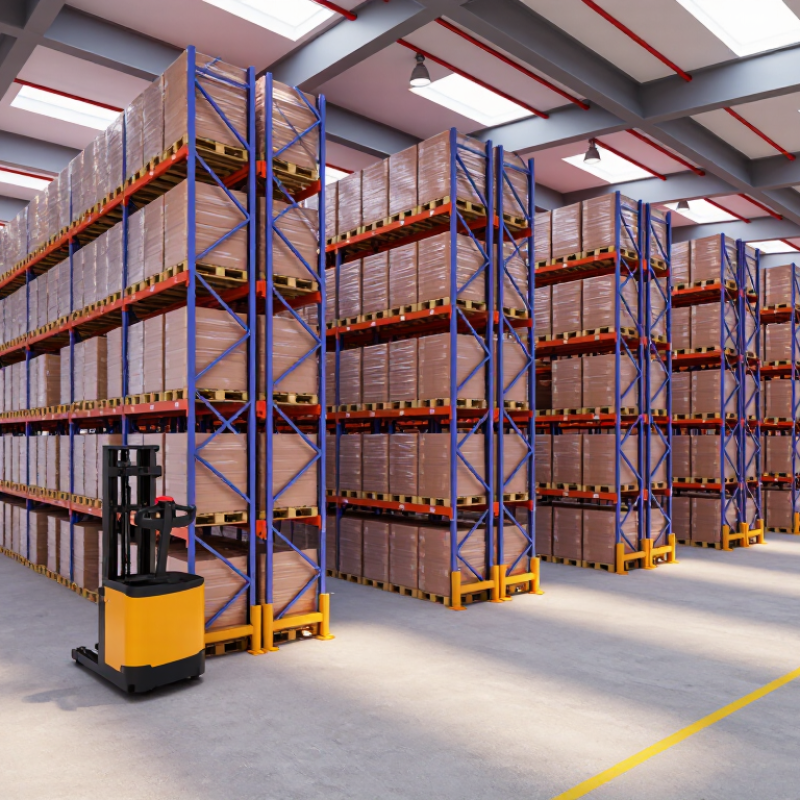
Drive-through pallet racking is a deep-lane storage system with access openings at both ends. A forklift loads pallets at one end and retrieves them from the opposite end, creating a first-in, first-out (FIFO) flow. That matters. The oldest pallet can move out first, which suits dated goods and products with limited shelf life. Pallets travel along rails, so loads should share compatible dimensions and usually the same SKU within each lane.
The MHI and Deloitte 2024 Annual Industry Report found that 55% of surveyed supply-chain professionals planned to adopt robotics and automation within five years. This measures technology plans, not the performance of pallet racks. Still, it highlights why predictable movement and accurate inventory records matter. In practice, staff need to keep loading and retrieval ends distinct; otherwise, a lane can become confusing. Labels help. So do clear floor markings and routine checks for damaged pallets or rails. Deep lanes can use floor space efficiently, but access to individual pallets is limited. That trade-off is easy to underestimate. A carefully planned FIFO lane can still lose its discipline when replenishment records lag behind forklift activity.
Drive-through pallet racking can reclaim floor space by letting forklifts enter storage lanes instead of serving every pallet from an aisle. Lane depth is commonly planned for 4–10 pallets, but the right number depends on product flow, pallet condition, and forklift maneuvering space. Deep lanes suit large quantities of the same SKU. They are less forgiving when stock turns unevenly.
WERC’s 2023 DC Measures report tracks warehouse capacity utilization as a key operating metric; it does not prescribe one universal lane depth. That distinction matters. A 10-pallet lane may look efficient on a drawing, yet slow retrieval if the rear pallet is needed before the front stock moves. Test the layout with real order history, not just peak inventory. Count pallet positions, then check access frequency and replenishment cycles. Leave room for imperfect pallets and cautious turns. Small details matter.
A practical review should map each lane to a single SKU where possible, confirm load heights, and verify forklift clearances with the equipment supplier. Four-deep may be easier to manage. Ten-deep may increase density, but can also increase handling steps and inventory rotation risk. Measure both. Often, the neatest plan needs revision.
Drive-through pallet racking can increase storage density by reducing the number of access aisles. Instead of serving every rack face, forklifts enter a lane and place pallets along its depth. More floor space can hold product rather than travel paths. That is the core advantage. It is not a free gain, though: deeper lanes mean fewer pallets are directly accessible.
Compare layouts using the same pallet dimensions, clearances, and operating assumptions. For example, a warehouse storing many pallets of the same product may use deep lanes efficiently, while a mixed inventory may need more selective access. Forklift turning space, rack height, load dimensions, and replenishment frequency all affect the result. A layout can look dense on paper but lose efficiency if operators wait for lane access or move pallets to reach stock behind them. Measure actual aisle space per stored pallet, not just rack capacity. Small details matter.
Tips: Group compatible products in dedicated lanes, confirm truck clearances with a qualified designer, and test the proposed flow against real picking patterns. Keep a little flexibility. Inventory changes, and a perfectly tight plan can become awkward surprisingly fast.
Compare modeled aisle area allocated per pallet position.
In this example, a 3.5 m aisle and 1.2 m pallet frontage are assumed. The selective-rack aisle serves two rack faces; the drive-in aisle serves a five-deep lane. This gives an estimated aisle allocation of 2.10 m² per pallet for selective racking and 0.84 m² for drive-in racking—a 60% reduction. Actual layouts vary with equipment, clearances, and site design.
Drive-through pallet racking suits stock that should leave in the order it arrives. A forklift loads pallets at one end of a lane and retrieves them from the opposite end. The first pallet in is usually the first pallet out. That matters for dated goods, changing batches, and products with a planned rotation schedule.
Drive-in racks work differently: loading and retrieval happen from the same end, so the last pallet stored is typically the first removed. This LIFO pattern can suit large quantities of similar stock with less frequent rotation.
FIFO needs two accessible ends, clear travel routes, and disciplined lane assignment. In a busy warehouse, a blocked exit can undermine the intended flow.
Not always. Pallet dimensions, forklift turning space, and load weights also affect whether a lane works safely.
I would check actual picking records before choosing; the layout that looks efficient on paper may not match daily demand. A simple trial with one representative lane can reveal delays, misplaced pallets, or awkward turns before the system is expanded.
Why Choose Drive-Through Pallet Racking?
Drive-through pallet racking can use floor space efficiently, but its layout leaves little room for guesswork. Forklifts travel into the rack lanes, where upright frames, rails, and stored loads shape the available clearance. A small mismatch can lead to contact, damaged pallets, or interrupted operations. Details matter.
Check the proposed rack against the applicable edition of ANSI MH16.1 and the project’s design criteria. Confirm pallet and product weights, load distribution, beam levels, rack height, and expected operating conditions. The rack designer or qualified engineer should verify that the configuration supports the intended loads. Do not assume a familiar-looking layout is rated for a new product or loading pattern.
Clearances need a separate, practical review. Compare the lane width and height with the actual forklift, pallet dimensions, load overhang, and placement tolerances. Account for rack components and expected structural deflection; the standard is not a substitute for equipment-specific clearance planning. Measure the tightest points, not just the open entrance. A few inches can matter. It is easy to underestimate how uneven pallets are in daily use. Record assumptions, confirm them on site, and revisit the design when loads or handling equipment change.
Forklifts enter deep lanes, reducing the number of access aisles. More floor space can hold pallets instead of travel paths.
Products with many pallets of the same type often fit well. Mixed inventory may need more selective access. That trade-off is easy to underestimate.
Operators may wait for lane access or move front pallets to reach stock behind them. A full-looking plan can still slow picking.
Use the same pallet sizes, clearances, and operating assumptions for each layout. Measure aisle space per stored pallet, not capacity alone.
Confirm pallet and product weights, load distribution, beam levels, rack height, and operating conditions. A qualified designer or engineer should verify the configuration.
Compare lane width and height with the actual truck, pallet, and load overhang. Check tight points inside the lane, not only the entrance.
Pallets may vary in size, and rack components can deflect under load. A few inches matter. I would not rely on neat drawings alone.
Recheck it when products, loads, or handling equipment change. Keep some flexibility; a very tight plan can become awkward fast.
Drive-Through Pallet Racking is a high-density storage system with access openings at both ends of each lane. This layout supports FIFO inventory flow: pallets loaded from one side are retrieved from the opposite side, helping stock move in sequence. Lane depth is commonly planned for about 4–10 pallets, depending on inventory volume, product movement, equipment, and available space. Deeper lanes can increase capacity, but should be balanced against access needs and stock rotation.
By storing pallets several positions deep, Drive-Through Pallet Racking can reduce the aisle space required per pallet compared with selective layouts. It is especially suited to goods that benefit from FIFO handling. Drive-in racking, by contrast, typically follows LIFO, with pallets loaded and retrieved from the same end. Before installation, verify pallet loads, clearances, and structural design against applicable ANSI MH16.1 rack design requirements and site conditions.